
ARR Meaning: What Is Annual Recurring Revenue?
What does ARR mean in business and finance? Learn the annual recurring revenue formula, SaaS examples, ARR vs MRR, and how to interpret growth.
Seeing $120,000 ARR on a business dashboard might sound like good news. A founder could easily assume the company has earned that much during the year. But the accountant might see things differently. Some customers have only recently subscribed, others have not made their next payment yet, and the business still has expenses to cover.
So, does that $120,000 really tell us how much the company has earned?
ARR meaning is Annual recurring revenue. It shows what the existing subscription base looks like in annual terms. It is quite helpful for SaaS companies; However, it solves a narrower task than 'How much did we earn?' Let us analyze it through the example of a fictional project management app along with all the necessary costs.
What is ARR?
The meaning of ARR is Annual Recurring Revenue: the annual value of eligible recurring subscriptions calculated on a certain date. So, think about ARR as a metric describing the subscriptions your business has at the moment, not its revenue record.
Let’s take a small project-management application that has 100 users who pay $50 per month each. It gives $5,000 in recurring revenue monthly or $60,000 annually. As you see, the formula is not that complex; the interpretation may be tricky sometimes. The customer can still cancel his subscription next month, and maybe your business does not yet get all twelve payments from everyone.
The tricky thing here is the abbreviation “ARR” itself. Some dashboards use it to refer to the annual run rate that also takes monthly plans into account. Others use stricter calculations where only the annual and multi-year contracts go into ARR calculations.
What is ARR in Business
ARR meaning in business is basically Annual recurring revenue that your business make. Tracking a one-time purchase is straightforward. A customer purchases an item; a transaction occurs. That is all there is to it. However, with subscriptions, the relationship between the seller and the buyer can continue on for months or even years, and the price will shift accordingly. With ARR, the seller can describe the ongoing relationship rather than lumping it into the month-to-month sales figures.
For our startup founder whose app is designed for managing projects, ARR in the amount of $60,000 provides a baseline. Is it more than three months ago? Was it because of the updates or because new clients were signed up? It is far more meaningful than simply treating it as a forecasted revenue figure.
- Growth planning: Know if the recurring subscription revenue is going up or down.
- Budgeting: Use recurring revenue trends to estimate future operating costs.
- Hiring: Think about whether there is enough demand and money for hiring more people.
- Communications with investors: Describe the size and trend of the subscription business.
There is a limit to what information the ratio can provide you with. Customers leave, contracts expire, and payments may be delayed.
These issues are not considered by ARR on their own. Additionally, ARR is not particularly informative when it comes to the retail store where customers make sporadic purchases. We hope now completely understand what is ARR in business means.
What Is ARR in Finance and SaaS?
Recurring revenue metrics are useful for finance people since they simplify the subscription performance tracking process. A SaaS company can have users who pay monthly, companies entering annual contracts, and bigger clients negotiating multi-year contracts.
ARR shows the qualifying contracts in an annual perspective as long as a certain method is used by the company. This annual perspective is not the same thing as financial reporting. For example, imagine that you have one client who pays $1,200 once for a year of usage.
The money goes to the company right away, while according to accounting revenue is recognized during the months of service provision. ARR defines the recurring annual metric but does not specify when money comes in, or when revenue is recognized.
It’s even more critical when dealing with a quickly growing company because of the possibility of a massive inflow of annual prepayments that will make the bank account look good on paper while costs associated with customer service, infrastructure, and payroll keep mounting. And this is what ARR meaning finance really means here.
The Annual Recurring Revenue is usually a non-GAAP operational measure. There’s no universal formula. Different companies can calculate the same things differently.
That’s why when you’re comparing figures from different businesses, don’t forget about their definitions. You may now have a good understanding of what is ARR in finance and SaaS.
How Does Annual Recurring Revenue Work?
Take the payment made by the customer for continuing usage and annualize the recurring payment. Add all the subscriptions that qualify according to the company’s criteria and you get the concept. This can be applied regardless of whether the customer is paying on a monthly basis or a yearly basis, though the eligibility criteria may differ depending on the company.
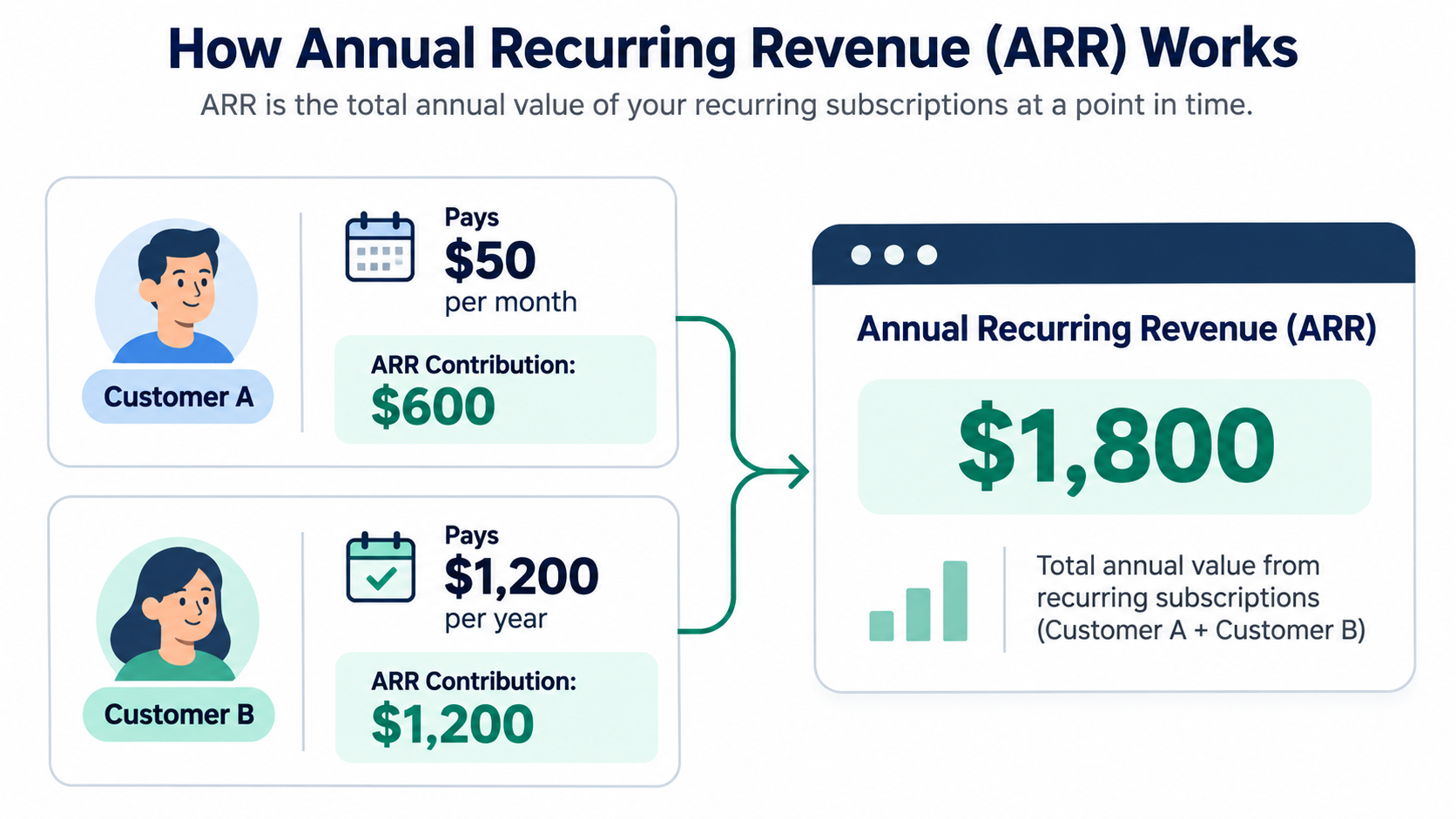
- Customer A pays $50 per month, resulting in an annualized recurring revenue of $600.
- Customer B pays $1,200 for an annual subscription, resulting in an annualized recurring revenue of $1,200.
Both customers contribute to recurring revenue, despite their invoices being different. Suppose now that the customer who pays on a monthly basis stops making payments or the customer with the annual subscription purchases another feature. The next ARR calculation will be different. This is because the ARR is only a snapshot of the existing base.
Which Revenue Counts Toward ARR?
This is where the seemingly simple formula gets murky. While the customer might be charged on a bill for software subscription, recurrent reporting feature, and a single setup consultation service, not all charges will be considered under the recurring revenue metric.
At the made-up firm of ours, the core plan will run you $50 per month. Suppose the same client also subscribes to the reporting feature at $10 a month. When added up, that makes for $60 monthly ($720 a year). The setup fee, when paid, is separate from everything else.
| Revenue type | ARR treatment |
|---|---|
| Monthly software subscription | Counts under annualized run-rate method |
| Annual subscription | Counts |
| Recurring paid add-on | Usually counts |
| Ongoing contracted service | Depends on policy |
| Usage-based charges | Depends on policy |
| One-time setup fee | Does not count |
| Nonrecurring consulting project | Does not count |
What Should Be Excluded From ARR?
Consider the case where the same client pays $200 for configuring the account. It is real money and it should be accounted for. However, the client does not agree to pay another $200 on a monthly or annual basis. It would distort the size of the recurring business by adding the fee to ARR.
- One-time setup or installation fees
- Nonrecurring consulting or training fees
- Sales taxes collected by authorities
- Cancelled subscriptions that are not active anymore
- Pending contracts and future clients
The discounts and free trials need to be considered separately, as well as the refunds and advanced payments of several years. There is no one-size-fits-all approach here. Future clients are a bit easier as long as the contract does not meet the criteria of the policy, any discussion with the client is not ARR.
How to Calculate ARR: Formula and Examples
The arithmetic is easy. But it is important to standardize the billing period. So let us first work with month-to-month billing and later work with annual. The figures below are illustrative only, not necessarily what a SaaS company should generate.
ARR Formula: Monthly Recurring Revenue × 12
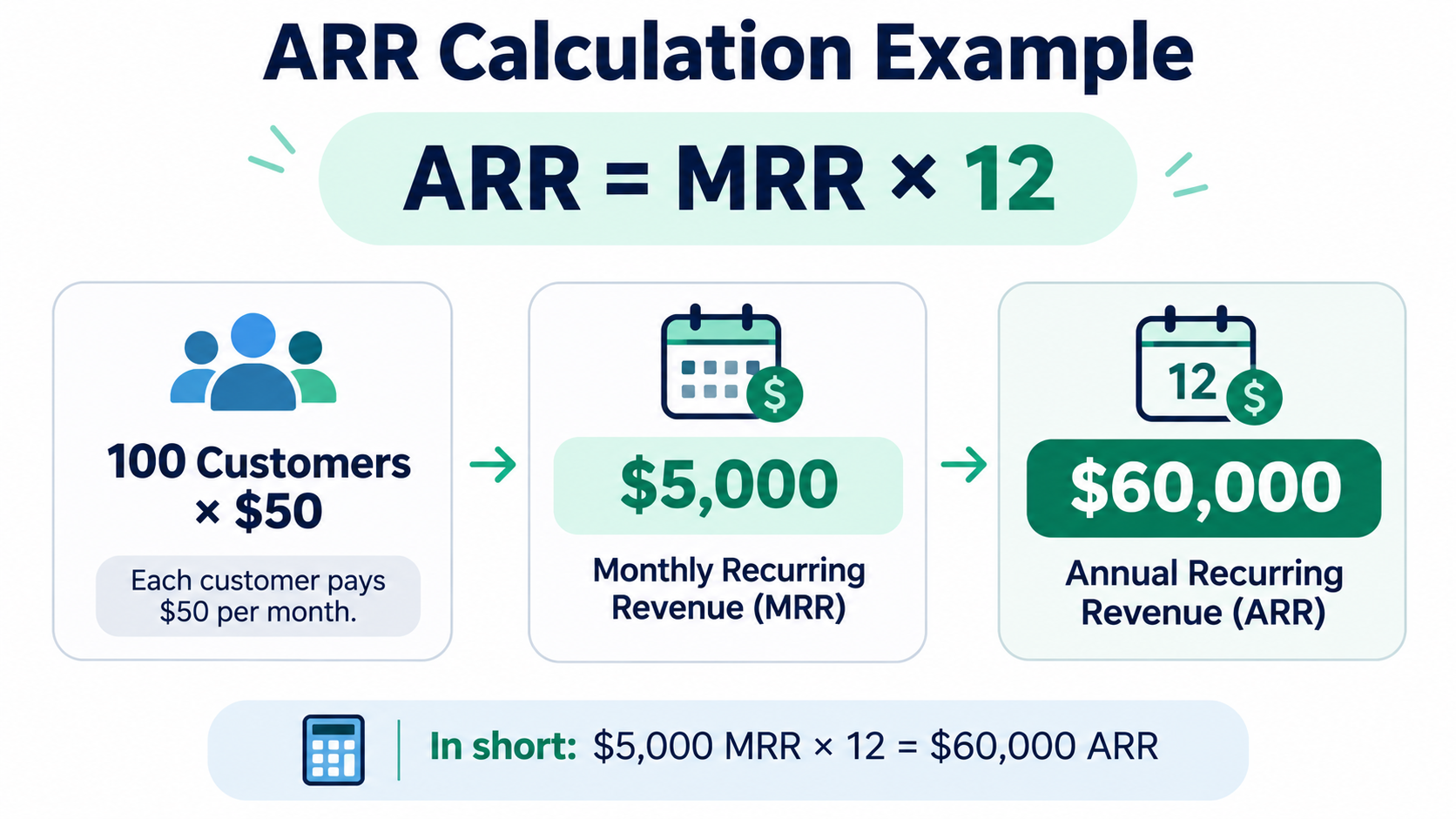
In case the organization uses ARR to represent Annualized recurring revenue, the formula would be ARR = MRR X 12. The MRR is the eligible amount that recurs every month. With 100 users of $50 each, then it will equal $5,000 MRR per month.
| Calculation | Amount |
|---|---|
| 100 customers × $50 | $5,000 MRR |
| $5,000 × 12 | $60,000 ARR |
But do not be misled into thinking that this gives you a sales forecast for next year. You must avoid being misled in such a way because it is just for measurement purposes at the current month rate.
How to Calculate ARR From Annual and Multi-Year Contracts
A one-year plan does not need much translation. If a plan is $1,200 annually for a year, then it translates into $1,200 of value each year. When translating multiple-year contracts, there is always the tendency of overestimating value; a $3,600 contract that lasts for three years gives an average of $1,200 per year.
| Contract | Total contract value | Annualized value |
|---|---|---|
| 12-month subscription | $1,200 | $1,200 |
| 3-year subscription | $3,600 | $1,200 |
| 2-year subscription | $4,800 | $2,400 |
This is on the presumption that the price is evenly distributed throughout the contract. A contract that offers discounted months or changing prices requires further analysis. In cases where an organization defines ARR according to the annual contract model, monthly contracts may even be absent from this metric.
Worked Example: ARR With Monthly and Annual Subscribers
We have been able to move beyond our initial offering of only monthly plans. We currently have 100 monthly customers paying $50 each and 20 annual customers paying $1,200 each. Instead of adding up all the invoices, we determine the contribution of each customer type per year.
| Subscription plan | Customers | Annual value/customer | ARR contribution |
|---|---|---|---|
| Monthly plan | 100 | $600 | $60,000 |
| Annual plan | 20 | $1,200 | $24,000 |
| Total | 120 | — | $84,000 |
These numbers are calculated using the run-rate method. The monthly team brings $60,000 annually while the annual team brings $24,000, for a total of $84,000. This is crucial because we are adding similar annualized figures, not combining a monthly number with an annual one.
How Does ARR Change as a SaaS Business Grows?
An ARR calculation is never constant. One user joins, another switches to an advanced package, and a third one decides not to pay any longer for that solution. And these actions may influence the overall ARR calculation from two opposite sides. At the beginning of the quarter, we have $84,000 ARR, but we need to find out what will follow.
New, Expansion, Contraction, and Churned ARR
| Movement | Meaning | Example |
|---|---|---|
| New ARR | Recurring value from new customers | A new business subscribes |
| Expansion ARR | More recurring value from existing customers | A customer upgrades |
| Contraction ARR | Less recurring value from existing customers | A customer downgrades |
| Churned ARR | Value lost through cancellation | A customer cancels |
Renewals can sometimes be misunderstood. If the client chooses to renew their current subscription at the same cost, then the company retains the same recurring revenue. The company does not acquire the same value in terms of ARR.
Calculate Ending ARR and ARR Growth Rate
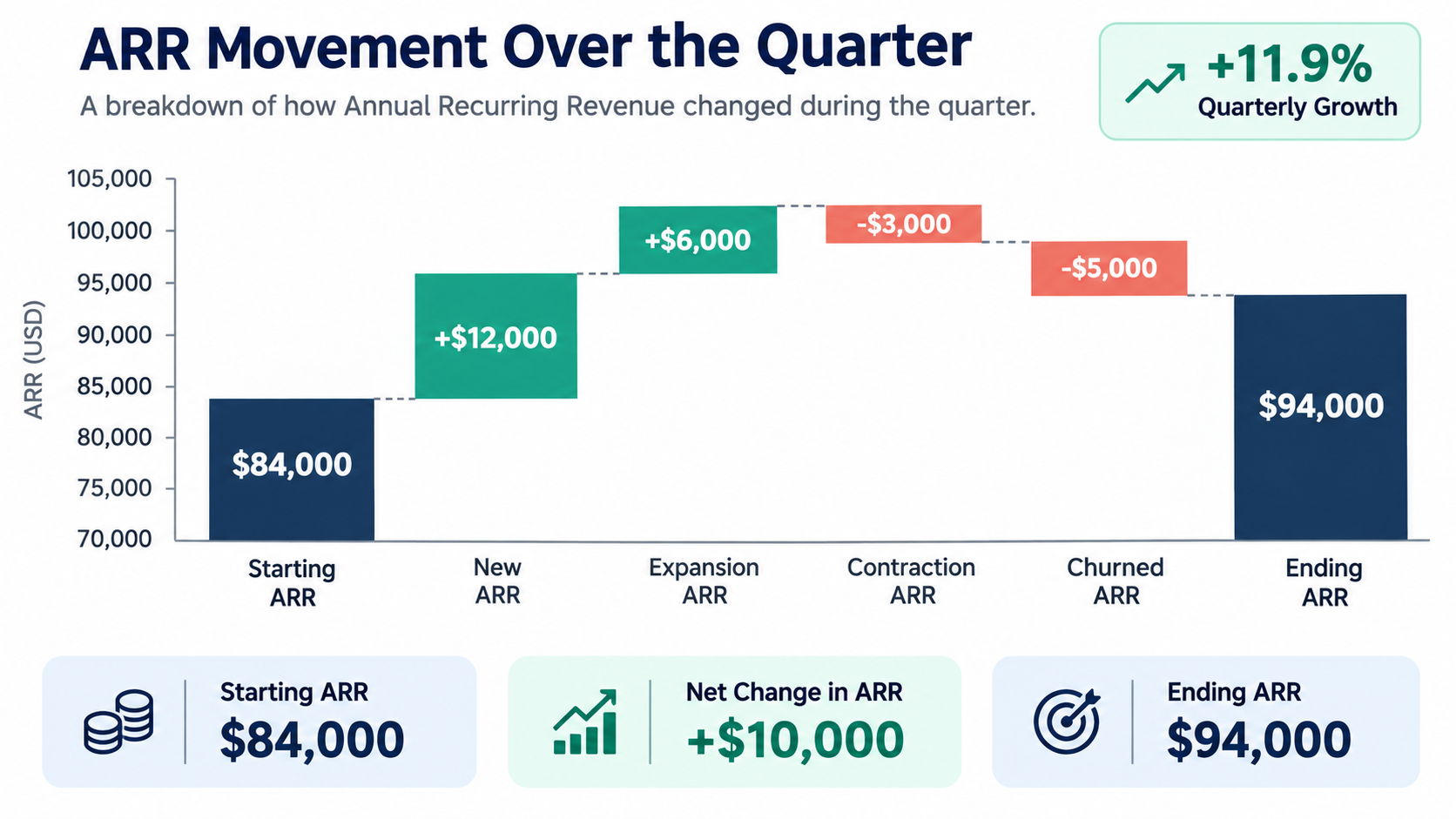
The calculation follows the customer changes: Ending ARR = Starting ARR + New ARR + Expansion ARR − Contraction ARR − Churned ARR. Adding and subtracting those movements gives the new recurring base, not merely a total of transactions during the quarter.
| ARR movement | Amount |
|---|---|
| Starting ARR | $84,000 |
| New ARR | +$12,000 |
| Expansion ARR | +$6,000 |
| Contraction ARR | −$3,000 |
| Churned ARR | −$5,000 |
| Ending ARR | $94,000 |
In our example, $84,000 grows to $94,000 after the gains and losses are accounted for. That's $10,000 of net growth, or about 11.9%: ($94,000 − $84,000) ÷ $84,000 × 100. The period here is one quarter. Calling it annual growth would be inaccurate.
ARR vs MRR: What Is the Difference?
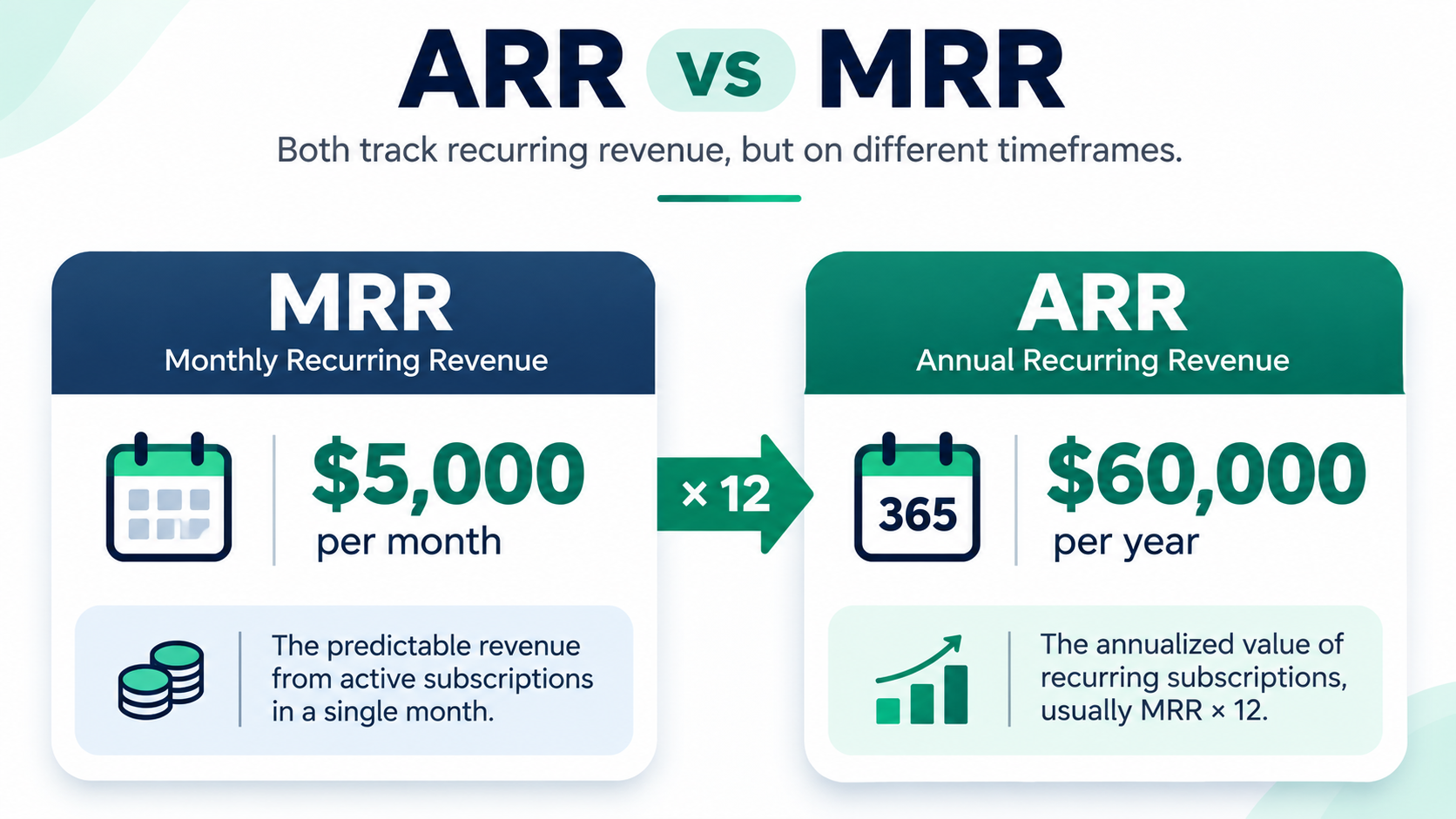
MRR and ARR are brothers from another mother, however, they are not interchangeable names. MRR states your qualifying recurring revenue on a monthly basis; while the meaning of ARR is on an annual basis. In case we have $5,000 MRR, it means that we are talking about $60,000 in terms of ARR.
| Comparison | ARR | MRR |
|---|---|---|
| Full form | Annual Recurring Revenue | Monthly Recurring Revenue |
| Time scale | Annual | Monthly |
| Basic formula | MRR × 12 | Eligible monthly recurring value |
| Example | $60,000 | $5,000 |
| Common use | Annualized scale and planning | Monthly performance |
| Limitation | Not guaranteed receipts | Not cash collected |
When you’re looking at the impact of a new initiative or a cancellation campaign, month-to-month changes will be more evident in MRR. ARR is helpful when considering the annual scope of the subscription base. Neither of them is a cash flow statement, nor do either of them consider the cost of producing the product.
ARR vs Revenue, Profit, and Annual Run Rate
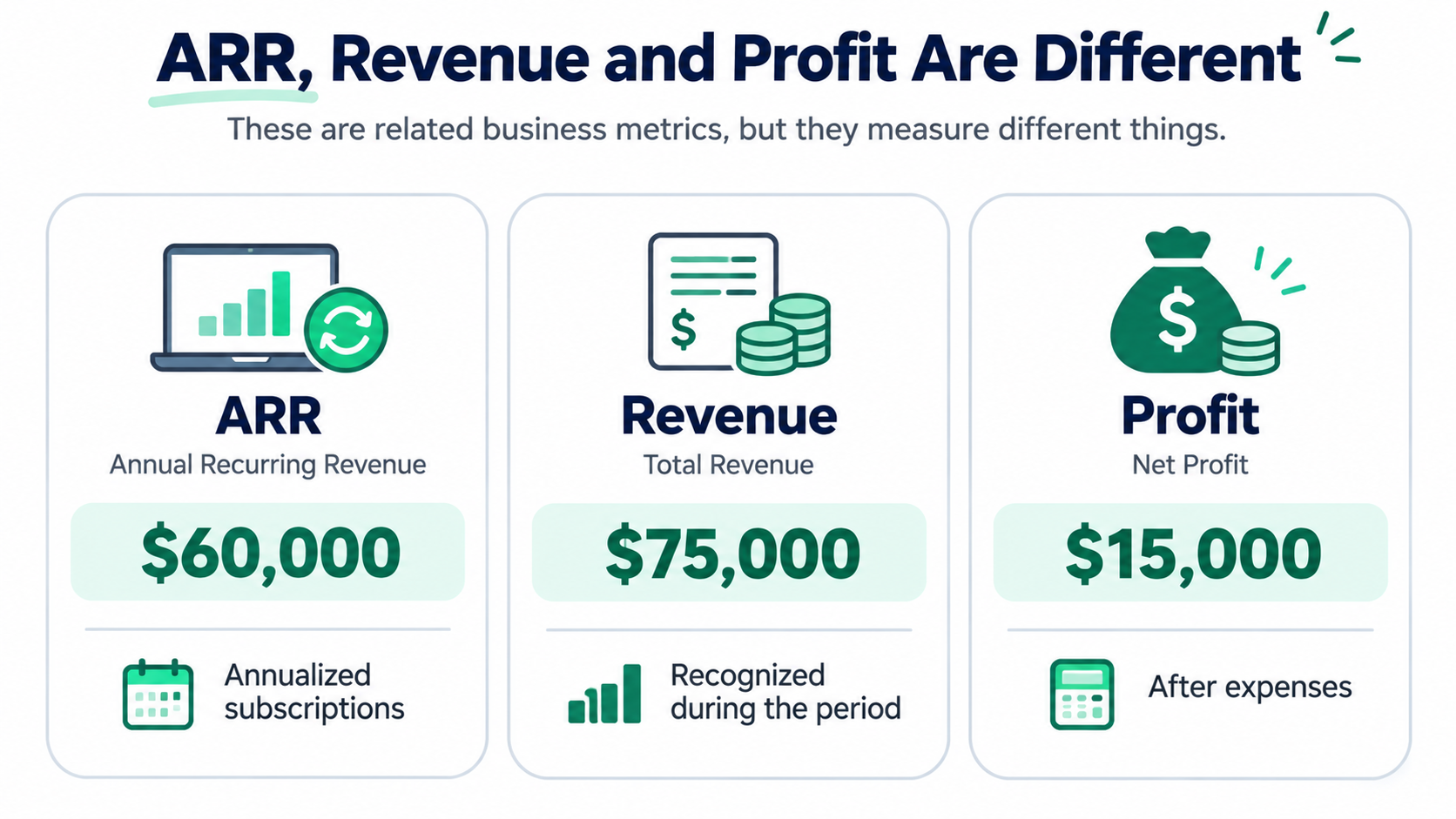
The founder of a company can proudly say "we have $100,000 ARR" and yet make losses. It seems contradicting only when we confuse ARR with the profit. These are the revenue recorded in the accounting books, the cash inflow, the cost of operations, and the annualized subscriber base.
| Metric | What it measures | Example |
|---|---|---|
| ARR | Annualized eligible recurring subscriptions | $60,000 from $5,000 MRR |
| Total revenue | Revenue recognized during a period | $75,000 from subscriptions and services |
| Profit | Revenue remaining after expenses | $15,000 after expenses |
| Annual run rate | A current revenue rate projected over 12 months | $10,000 monthly × 12 = $120,000 |
Here is yet another pitfall when naming. The general annual run rate could take a single month’s total revenue, which may include onetime work, and multiply it by twelve. The subscription ARR should be calculated from qualified recurring revenue. Check how it was derived before comparing it to others.
Why Is ARR Important for a Business?
Why should you measure ARR if it does not provide you with complete information about your company? The answer is quite simple by monitoring ARR, you will make one of the critical components of your business visible, namely, the recurring value that your current customers create. It will be a reason for you to analyze the situation and take action.
Our app showed $94,000 in ARR at the end of the quarter under discussion compared to $84,000 that we had at the beginning. That is good news indeed, but we still lost $8,000 thanks to cancellations and downgrades.
If you do not pay attention to it, you risk ignoring some problems connected with onboarding and the value of the product.
Enter Pro's SaaS website builder guide offers related context for founders designing those pages. Even a well-designed site, though, won't make ARR a substitute for churn, margins, or cash flow.
Forecasting, Budgeting, and Investor Reporting
Although recurring subscriptions will reduce the guesswork in your forecasting and budgeting, they won’t make it automatic. Take the example where the founder intends to hire a support specialist.
The hiring process should be based on forecasts, including subscription renewals and cancellations, payroll, and reserves, not just the ARR shown on the slide.

Your finance department can develop its own budget trackers and forecasting workflow tools. For instance, you can use Enter Pro’s AI for Finance tool. Any workflow that you develop will have to be tested against real data; your customized dashboard does not mean that it becomes your accounting system or ARR calculator.
ARR, Retention, and Customer Churn
The net value from new subscriptions and upgrade was $18,000, while that from cancellation and downgrade was $8,000. Given the rising rate of departures, it may be the case where the cost of customer acquisition becomes a zero-sum game.
Churn is calculated by departed customers. Churn revenue is calculated as the recurring revenue that has been lost. Net revenue retention (NRR) calculates recurring revenue from existing customers, including upgrade and downgrade, but not new customers.
Common ARR Calculation Mistakes to Avoid
An ARR report can be inaccurate when setup fees are counted as subscriptions, annual contracts are double-counted, or potential clients are included in the numbers.
| Mistake | Why it matters | Correction |
|---|---|---|
| Including setup fees | Inflates recurring value | Exclude one-time charges |
| Counting potential customers | Includes unsecured revenue | Count eligible active subscriptions |
| Double-counting contracts | Overstates value | Normalize each contract once |
| Mixing billing periods | Creates inconsistent totals | Convert to a common annual basis |
| Treating renewals as new ARR | Overstates growth | Record unchanged renewals as retained |
| Ignoring discounts | Overstates recurring value | Follow documented discount policy |
| Comparing different definitions | Misleading comparisons | Check policies and dates |
The measurement date and inclusion policy should always go together with the graph to ensure accurate comparisons.
How to Improve ARR Without Misreading the Metric
You can increase ARR by charging clients more, but if they find no value in your offer, they'll downgrade or unsubscribe.
It would be useful to have advanced reporting features for those who generate reports every week. It will not be useful for the freelancer having two projects.
- Customer fit: Identify companies that need the software.
- Retention: Study subscription cancelations and downgrades.
- Valuable upgrades: Include features that can bring some value to clients.
- Price analysis: Evaluate price changes along with subscription cancellations.
- Customer experience: Optimize onboarding, customer support, and renewals.
Watch how clients behave when price or product changes occur, whether they remain with the company and make use of new features.
Build Your SaaS Business Website With the Help of Enter Pro

People looking at new software need to know what it does, what each one contains, and if paying yearly impacts the cost.
Enter Pro's SaaS Website Builder could be used for your fictional project management app to present information on the product and pricing.
Step 1: Choose a Website Layout
Sign in to your account and start a new project. Start by choosing a layout that suits your software and its users. Think about how you want to present the homepage, features, and pricing so visitors can easily find what they need.
Step 2: Build Your Homepage
Create a homepage that explains what problems your software can solve. You can introduce your project management app and show how it helps people organize their work.

Step 3: Add Product Features
Provide accurate information about the product features and some usage cases. This helps visitors understand what the software offers and whether it meets their needs.

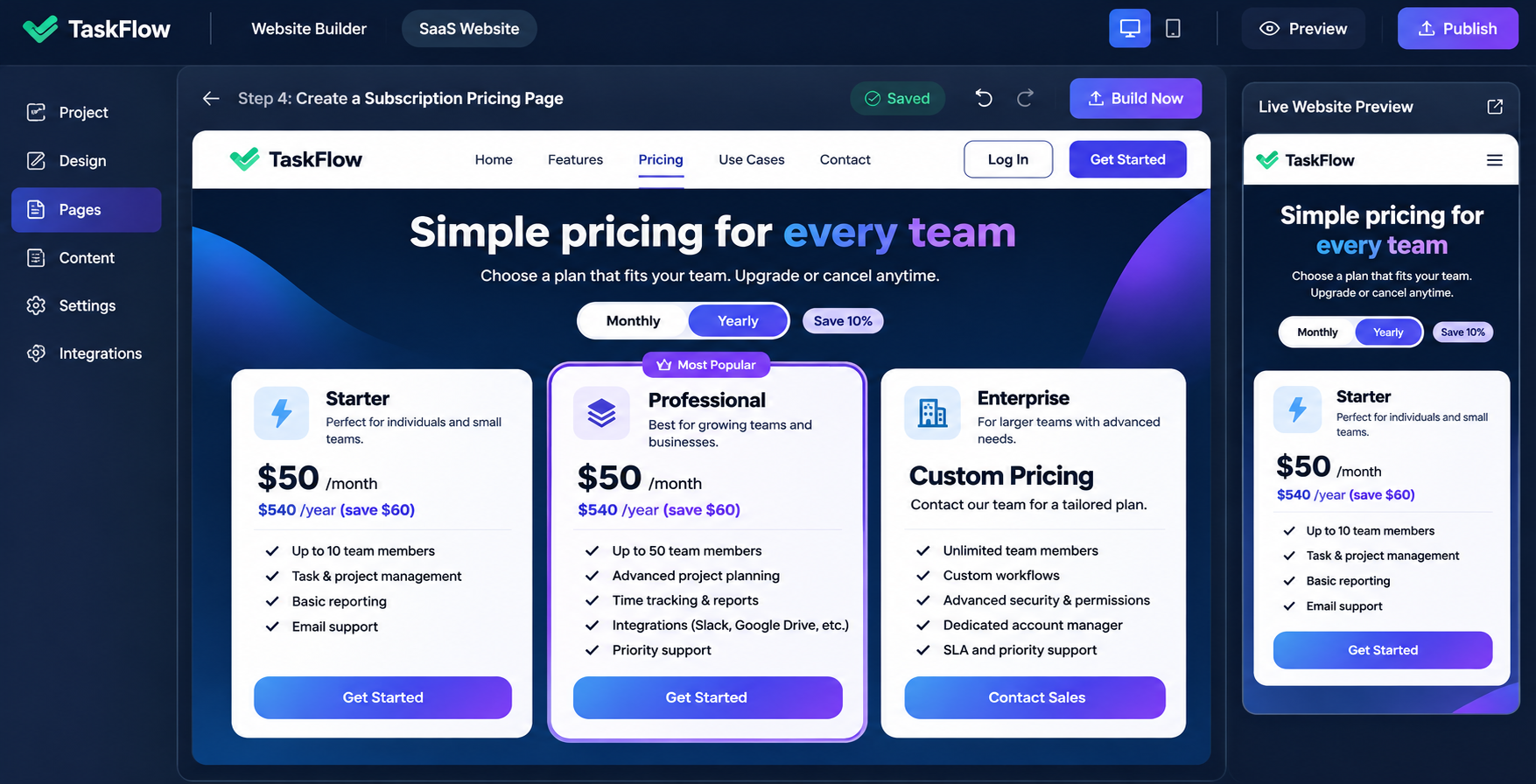
Step 4: Create a Subscription Pricing Page
Build a pricing page where visitors can compare monthly and yearly subscription plans. Keep the prices and included features clear so people can understand what each option offers.
Step 5: Add Subscription and Demo Options
Provide subscription or demo options together with an explanation of what happens next. Visitors should know whether they can start using the software, request a demo, or contact your team.
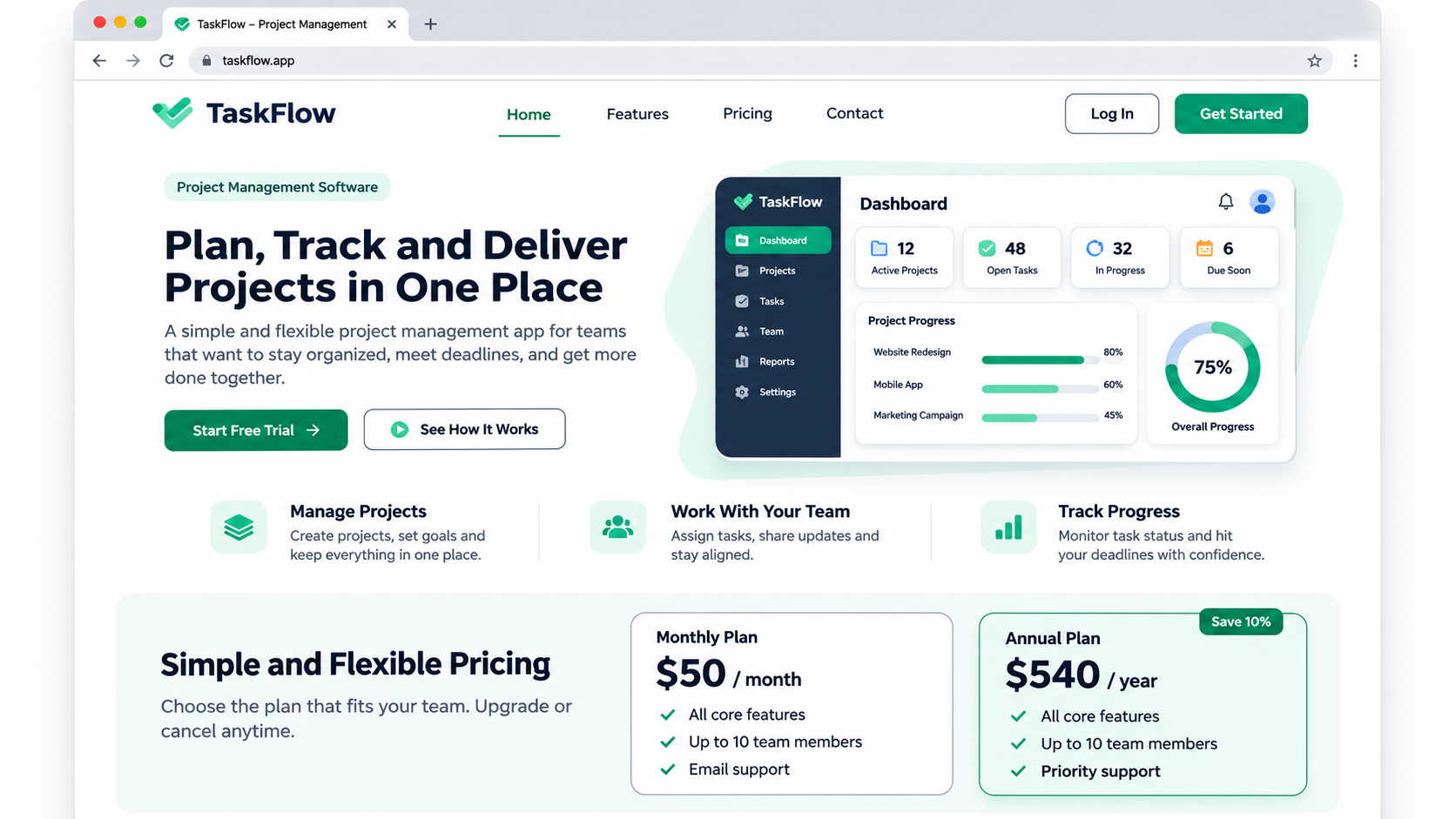
Suppose that the pricing page shows $50 monthly or $540 yearly. In case of an annualization of the ARR model, the monthly customer will have an input of $600, and the yearly customer will have an input of $540. The website is capable of offering both options. However, other tools will be needed for processing payments and accounting.
Final Verdict: What Does ARR Tell You?
ARR meaning is basically knowing about the number of qualifying subscriptions at a certain time. Still, ARR cannot tell whether that money has been received by the business firm, how long subscribers will be subscribing, or whether costs are under control.
You should ask yourself three questions while analyzing an ARR report. First, what subscriptions were counted in ARR? Second, what time was used in the calculation of the metric? And lastly, how about cancellations or upgrades?
Finally, you can use Enter pro's SaaS builder to create your own app to present software, features, and subscription plans to potential customers.
FAQs About ARR Meaning
What does ARR mean in business?
Meaning of ARR is Annual Recurring Revenue. This measure converts the worth of qualifying subscriptions into annual terms, enabling businesses to measure recurring revenue. It is different from the revenue earned in the year or the net income minus expenses. The number may also differ depending on the contracts considered.
What does ARR mean in finance?
In finance, ARR is used to evaluate the subscription pattern and talk about recurring revenues with founders or investors. Yet, ARR is not an alternative to revenue, cash flow, and profits. As ARR lacks a standard accounting formula, the definition of ARR and the measurement date should be mentioned.
What is ARR in SaaS?
ARR in SaaS measures the annualized value of qualifying software subscriptions, including eligible recurring upgrades. It changes when customers subscribe, upgrade, downgrade, or cancel. Enter Pro's SaaS Website Builder can help founders present their software and subscription plans, but ARR reporting still requires accurate subscription and billing data.
How do you calculate ARR?
Multiply eligible MRR by 12. For example, if there are 100 customers that pay $50 per month, the MRR will be $5,000, and the annualized ARR will be $60,000. Annual contracts can be counted yearly, whereas multi-year contracts will need to be normalized. Keep the inclusion criteria consistent throughout the report.
Does ARR include one-time fees?
Not really. One-time onboarding or setup fees are not included in ARR, even when they appear on the same invoice as a subscription. However, recurring subscription add-ons may count depending on the company's policy. Including one-time charges in ARR would overstate the business's recurring revenue.
Can I use Enter to build a SaaS website?
Enter Pro's SaaS Website Builder can be used to design pages that help visitors learn about your software, compare subscription plans, and sign up or request a demo. It is a website builder, not an automated ARR calculator. Founders should check billing, payments, customer accounts, and integrations separately.