

From MiniMax M2.5 to Real AI Productivity: Why Tools Matter More Than Models
MiniMax M2.5 is fast, powerful, and cost-effective—but can it truly replace workflows? Discover its strengths, limitations, and why tools may matter more than models.
The release of MiniMax M2.5 is an important milestone for the AI ecosystem. We are finally seeing an open-weight model capable of orchestrating complex agentic workflows at a fraction of traditional enterprise costs. The models are quickly shifting from mundane chatbots that answer your questions to ones that can execute workflows.
However, having access to raw capability does not automatically mean your daily output will improve. In this hands-on MiniMax M2.5 AI model review, I will break down my experience with this system, analyzing its benchmark-topping performance and revealing why the real bottleneck is no longer the model. It is simply how you deploy it.
What is MiniMax M2.5?
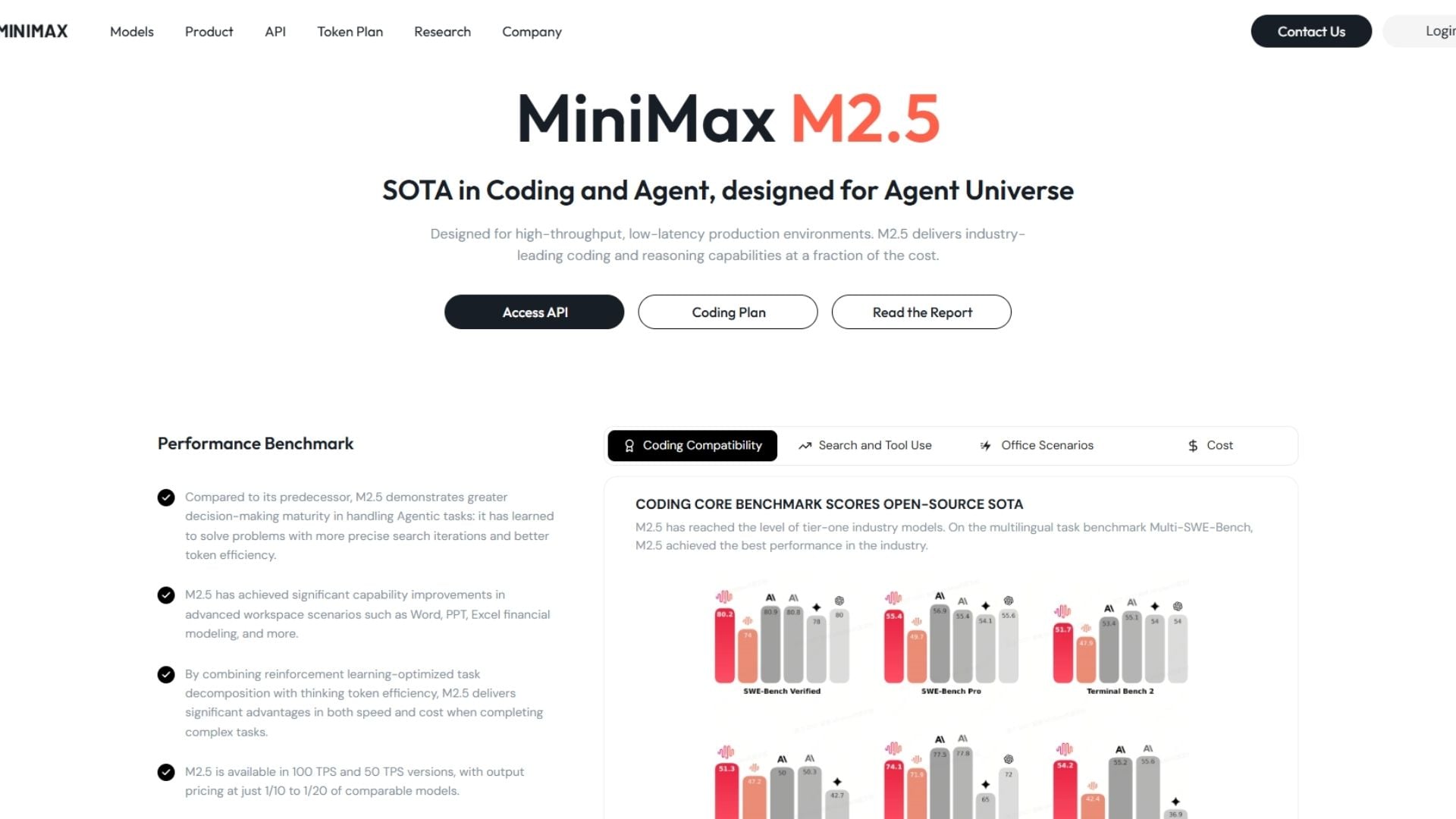
MiniMax M2.5 is a state-of-the-art LLM engineered specifically to handle complex coding and real-world office productivity. Released on February 12, 2026, it utilizes a massive 230B-parameter Mixture of Experts (MoE) architecture.
During my evaluations, I tested its impressive 205,000-token context window and its unique positioning as a "spec-first" agent. Users can access the ecosystem via numerous API providers, including the blazing-fast Together AI MiniMax M2.5 model endpoint. This wide availability makes it highly accessible for developers wanting an alternative to Claude or GPT-4.
What Makes MiniMax 2.5 Stand Out?
There are several reasons why MiniMax 2.5 has attracted attention across the development landscape.
Advanced Task Decomposition

During my testing, the model consistently exhibited what its creators call native "spec behavior." MiniMax M2.5 can analyze a high-level instruction and convert it into actionable steps.
It architects the UI design and backend logic conceptually before outputting a single line of code. This “spec-first” capability is crucial for building AI agents, ensuring complex projects do not immediately derail due to a lack of structural planning.
Strong Coding and Workflow Support
From writing scripts to debugging full applications, MiniMax-M2.5 performs at a high level in software engineering benchmarks such as SWE-Bench Verified, Multi-SWE-Bench, and Terminal Bench, placing it among top-tier models in real-world coding tasks.
Here is a breakdown of its verified capabilities:
| Benchmark | Score | What It Measures | Why It Matters |
|---|---|---|---|
| SWE-Bench Verified | ~80.2% | Fixing real GitHub issues in real repositories | Gold standard for real-world software engineering capability |
| Multi-SWE-Bench | ~51.3% | Cross-repo, multi-language coding tasks | Tests system-level reasoning across complex environments |
| SWE-Bench Pro | ~55.4% | More difficult engineering tasks | Measures performance under higher difficulty scenarios |
| SWE-Bench Multilingual | ~74% | Coding across multiple languages | Shows generalization beyond English-based codebases |
| Terminal Bench (v2) | ~51.7% | Task completion in terminal/tool environments | Reflects agent-style coding workflows (not just generation) |
| BrowseComp | ~76.3% | Search + reasoning + execution | Simulates real-world debugging with external information |
| VIBE-Pro (internal) | N/A (relative) | Complex software engineering workflows | Indicates performance in full-stack or long-chain tasks |
| Office/Productivity Eval | ~59% win rate | Document, spreadsheet, workflow tasks | Shows capability beyond coding into real productivity |
Productivity Across Domains
Beyond coding, MiniMax M2.5 supports document generation, spreadsheet automation, and structured business workflows. It boasts an impressive 59% win rate against mainstream models in pairwise comparisons for handling Excel and PowerPoint tasks. [Internal Link: "leveraging AI for office productivity automation"]
Impressive Cost Efficiency
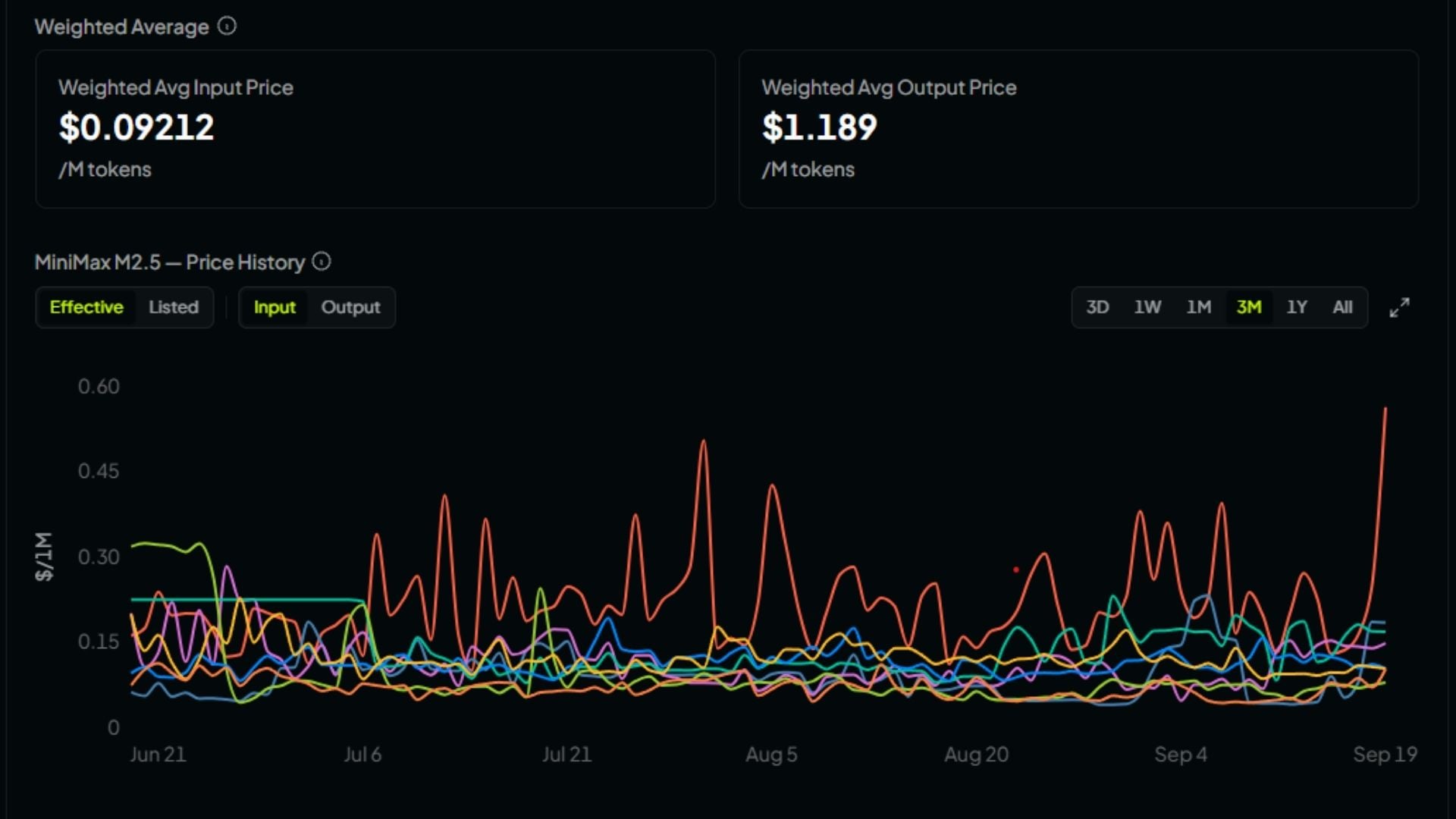
The MiniMax M2.5 API pricing is 5–20x cheaper than most top-tier models, blending input and output costs around $0.44 per million tokens on budget providers. Its pricing is closer to lightweight models, but performance is closer to flagship models.
This creates a rare positioning: “High-end capability at near-commodity pricing”. Combined with claims of MiniMax M2.5 free usage tiers or near-zero cost experimentation on open platforms, it lowers the barrier to entry dramatically.
However, lower pricing does not necessarily translate into lower total cost—especially when usability, workflow design, and iteration time are taken into account.
| Model | Input Price (per 1M tokens) | Output Price (per 1M tokens) | Relative Cost | Positioning |
|---|---|---|---|---|
| MiniMax M2.5 | ~$0.15 | ~$0.90 | 🟢 Very Low | High-performance + ultra cost-efficient |
| GPT-4o (OpenAI) | ~$5.00 | ~$15.00 | 🔴 Very High | General-purpose flagship model |
| Claude 3.5 Sonnet | ~$3.00 | ~$15.00 | 🔴 High | Strong reasoning & coding |
| Claude 3 Haiku | ~$0.25 | ~$1.25 | 🟡 Low | Fast + lightweight |
| Gemini 1.5 Pro | ~$3.50 | ~$10.50 | 🔴 High | Long-context + multimodal |
| Mistral Large | ~$2.00 | ~$6.00 | 🟠 Medium | Enterprise-focused LLM |
Why MiniMax 2.5 Feels Like a Turning Point
Historically, deploying capable AI meant choosing between extreme cost and poor reasoning. By removing old constraints, the MiniMax M2.5 AI model release signals a shift, where capability is no longer scarce.
- Performance is no longer the main issue, as open-weight models achieve 80%+ on SWE-Bench Verified.
- Cost is no longer the main barrier, given the incredibly cheap token execution rates.
The industry is entering a new era where raw intelligence is commoditized and accessible to anyone willing to tap into it.
The Hidden Challenges of Using MiniMax M2.5
Despite phenomenal benchmarks, integrating the model into a daily routine is not entirely seamless.
Complexity of Direct Usage
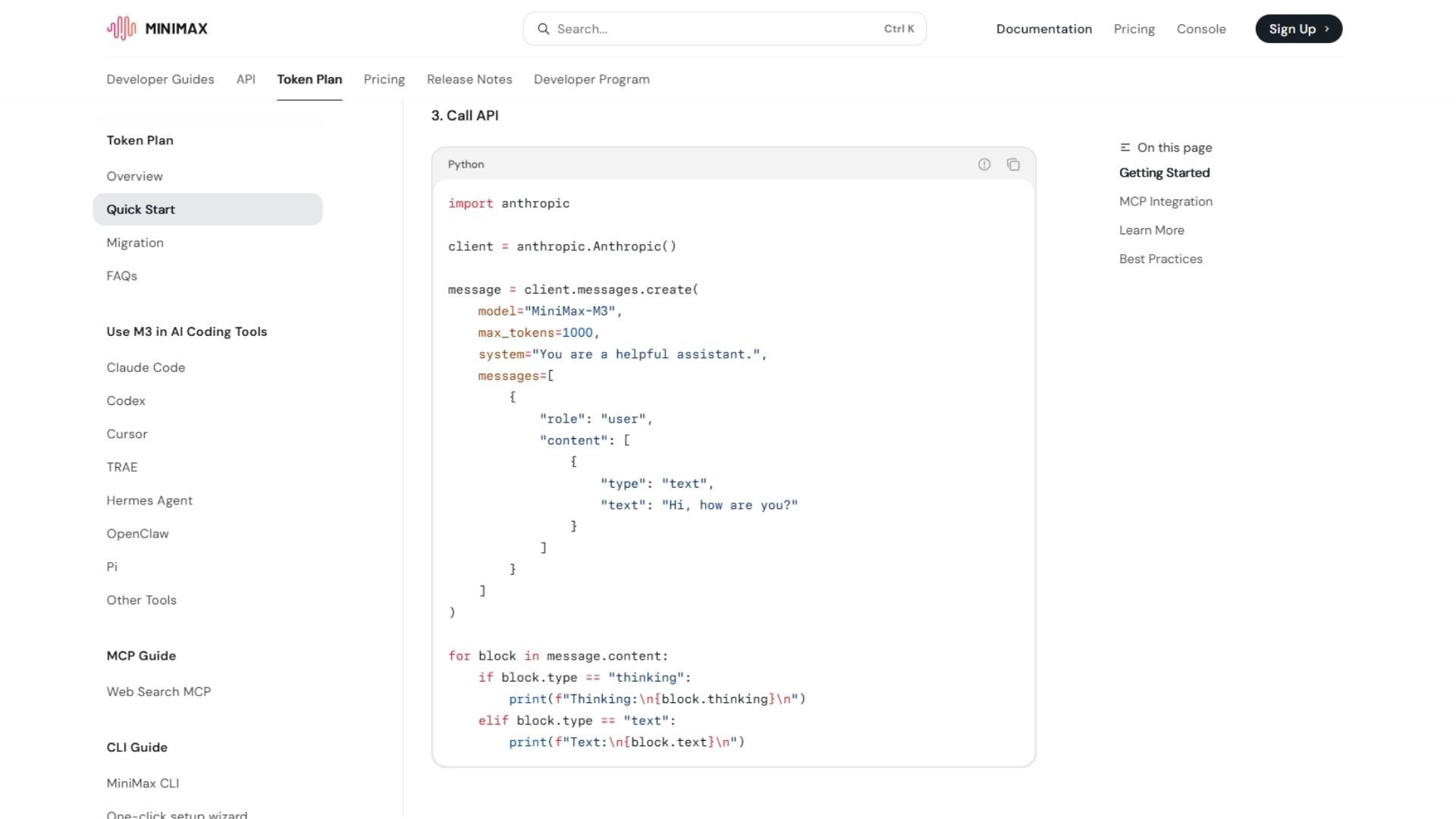
Using this model directly via an API requires significant prompt engineering required to maintain its reasoning logic.
There is a steep API integration effort, creating a high learning curve for non-technical users who are not comfortable managing scripts, headers, and token limits.
Lack of Built-in Workflows
Model ≠ Product. A language model is effectively a brain in a jar without an interface.
Users must:
- Design flows and user interfaces.
- Chain prompts together for multi-step tasks.
- Handle logic manually and build the surrounding infrastructure.
Output Variability
Even with advanced reasoning, you will encounter the classic problem: same MiniMax-M2.5, different results.
Output consistency depends entirely on:
- Input structure and clarity.
- Context quality provided in the prompt.
- User expertise in guiding the model back on track.
Powerful models like MiniMax M2.5 shift the challenge from access → execution. Anyone can get their hands on the latest models, but only a few can use all of it's capabilities.
The Shift: From Choosing Models to Choosing Tools
As models like MiniMax M2.5 become more powerful and accessible, the real differentiation is moving elsewhere. It is no longer just about which model you use, but:
- How easily you can use it.
- Whether it fits into your workflow.
- How consistent the results are.
This is where a new layer of products begins to matter, bridging the gap between raw intelligence and tangible, deployed outcomes.
Where Tools Like Enter Pro Come In
Instead of interacting directly with raw models like MiniMax M2.5, some platforms are focusing on simplifying the experience. Solutions such as Enter Pro aim to:
- Abstract away prompt complexity.
- Provide built-in workflows.
- Deliver more consistent outputs.
Rather than competing with models like MiniMax M2.5, these tools build on top of them—turning raw capability into practical productivity. You can finally start building the startup you always wanted to.
How to Use Enter Pro for Visual Development
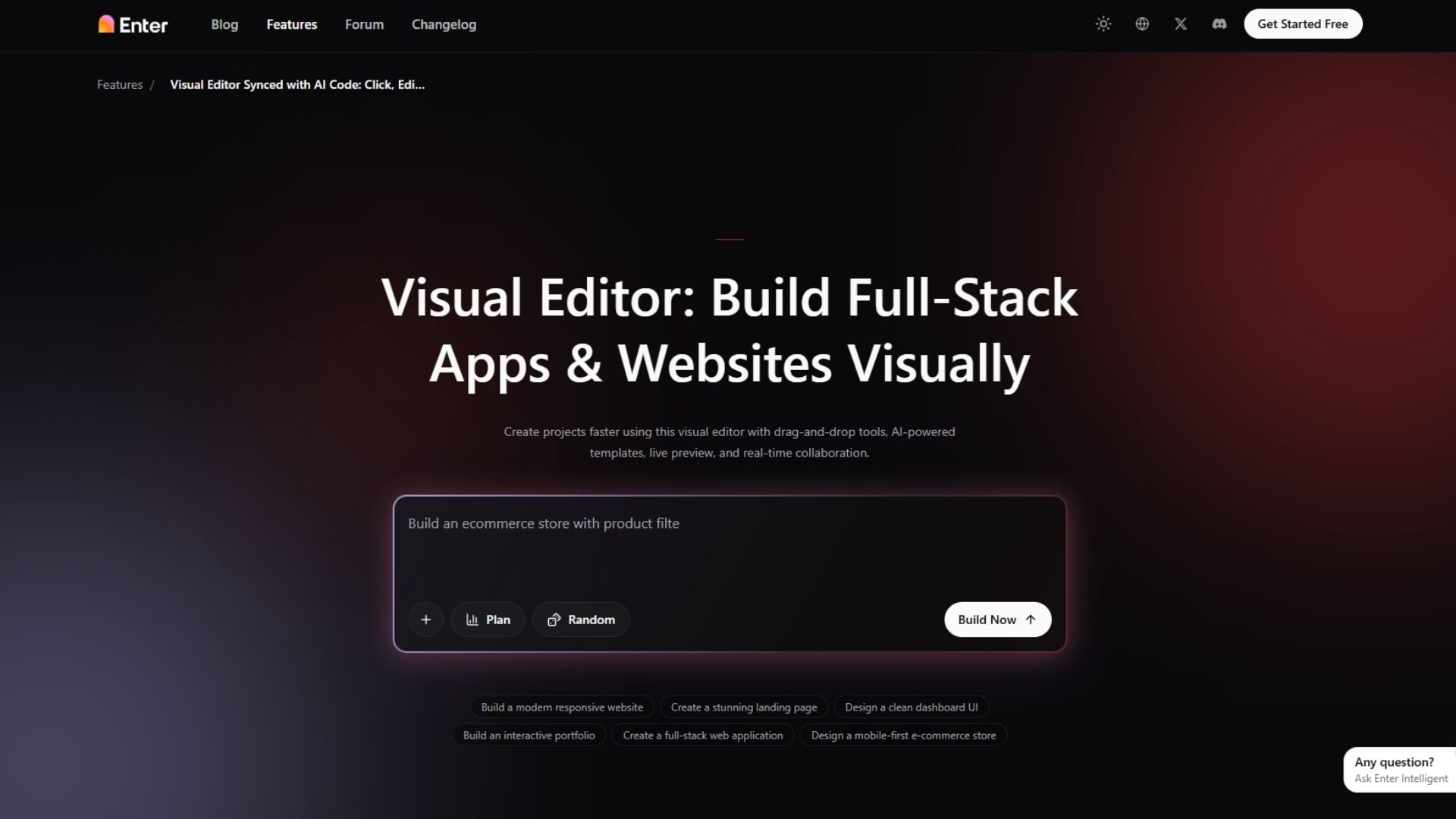
If managing API endpoints sounds tedious, visual development is the solution. Here is how to transform ideas into software with Enter Pro:
| Step 1: Define Your Vision | Type out your application concept using natural language in the Enter Pro dashboard. You don’t need to worry about complex system prompting. The tool structures your requirements automatically. |
|---|---|
| Step 2: Review the AI Blueprint | Enter Pro takes your idea and creates an interactive visual plan that outlines the frontend UI and database logic. You can tweak and approve this blueprint visually before any code is generated. |
| Step 3: Publish and Iterate | Once approved, hit the "Build" button. Enter Pro generates the full stack, hosts it, and provides a live URL. |
Final Thoughts: The Real Decision Isn’t About Models
The arrival of MiniMax M2.5 marks an important milestone in AI development. With strong performance, low cost, and increasing accessibility, it represents the future of intelligent systems.
But it also exposes a deeper truth: The biggest challenge is no longer access to powerful AI—it’s knowing how to use it effectively. For developers, working directly with MiniMax M2.5 offers flexibility and control.
For everyone else, the question becomes simpler: Do you want to build workflows yourself? Or use tools that already make them work? Enter Pro might be able to give you a better answer.
FAQs
What is MiniMax M2.5 best suited for?
It excels in real-world software engineering, bug fixing, and complex office productivity tasks like automating Excel and PowerPoint workflows through API integrations.
Can beginners use MiniMax M2.5 directly?
Direct usage requires programming knowledge to manage API endpoints and context windows. Beginners are much better off using platforms that abstract the model behind a visual interface.
Why do results vary so much with MiniMax M2.5?
Output quality heavily relies on prompt structure, context management, and the user's ability to clearly define constraints. Vague instructions inevitably lead to inconsistent results.
Does MiniMax M2.5 replace traditional tools?
No. It acts as an underlying reasoning engine that requires a separate interface or workflow builder to truly replace a full toolset for non-technical users.
Is low pricing enough for enterprise adoption?
While low API costs are highly attractive, enterprises also require robust data security, polished user interfaces, and reliable workflow integrations before full-scale adoption occurs.
Is MiniMax M2.5 Free?
While the open-weights model can be downloaded and run locally for free, most users access it through paid—but highly affordable—API providers.
How to run MiniMax M2.5 locally
You need substantial GPU resources to run a 230B-parameter MoE model locally. Frameworks like Ollama or vLLM can be used, provided your hardware meets the heavy memory requirements.
How big is MiniMax M2.5
It is built on a 230-billion-parameter Mixture of Experts (MoE) architecture, with approximately 10 billion active parameters utilized during each forward pass.