

What is a Pitch Deck? Meaning, Purpose, Types, and Key Slides
Learn what a pitch deck is, its purpose, and the types used for startups, films and sales pitches. Then build the website that backs your raise with Enter Pro.
What is a pitch deck? It is a short, visual presentation that explains a business, film, or sales idea to an audience whose decision matters, most often investors. Its job is to earn the next conversation, not to close a deal on its own. Decks vary by use case, but they share the same core logic. Below are the purpose, the main types, the must-have slides, a four-step build process, and a way to publish the website that usually accompanies a fundraising pitch.
What is a pitch deck?
A pitch deck is a concise slide presentation that summarizes an opportunity, such as a startup, a film, or a client proposal. The purpose of a pitch deck is to communicate that opportunity clearly and quickly enough that the audience wants a follow-up conversation, meeting or deal.

What is the goal of a pitch deck?
What is the purpose of a pitch deck? Most people conflate two goals. The immediate goal is small: a meeting, a second call, a "let's talk more." The long-term goal is the outcome that meeting makes possible, such as funding, a greenlight, or a signed client. A deck that tries to reach the long-term goal in a single sitting usually overloads its slides and loses the room.
A deck also differs from a business plan or a script. It is a summary designed to provoke questions, while the plan or script holds the complete detail.
What is a pitch deck used for? Types by business, film, and sales
The purpose of a pitch deck stays the same across audiences: to earn the next step. What changes is the emphasis, since pitch decks serve three main audiences: investors, studios or networks, and prospective clients.
| Deck type | Who uses it | Main goal | Typical length |
|---|---|---|---|
| Business/investor | Founders raising capital | Secure a follow-up meeting, then funding | Roughly 15-24 slides, depending on stage |
| Film/TV | Writers, producers, showrunners | Sell a story to a studio, network, or partner | Often 10-20 visual pages |
| Sales | Account teams, agencies, B2B sellers | Win a client or approval for a proposal | Usually 8-15 slides, tailored per prospect |
What is a pitch deck in business?
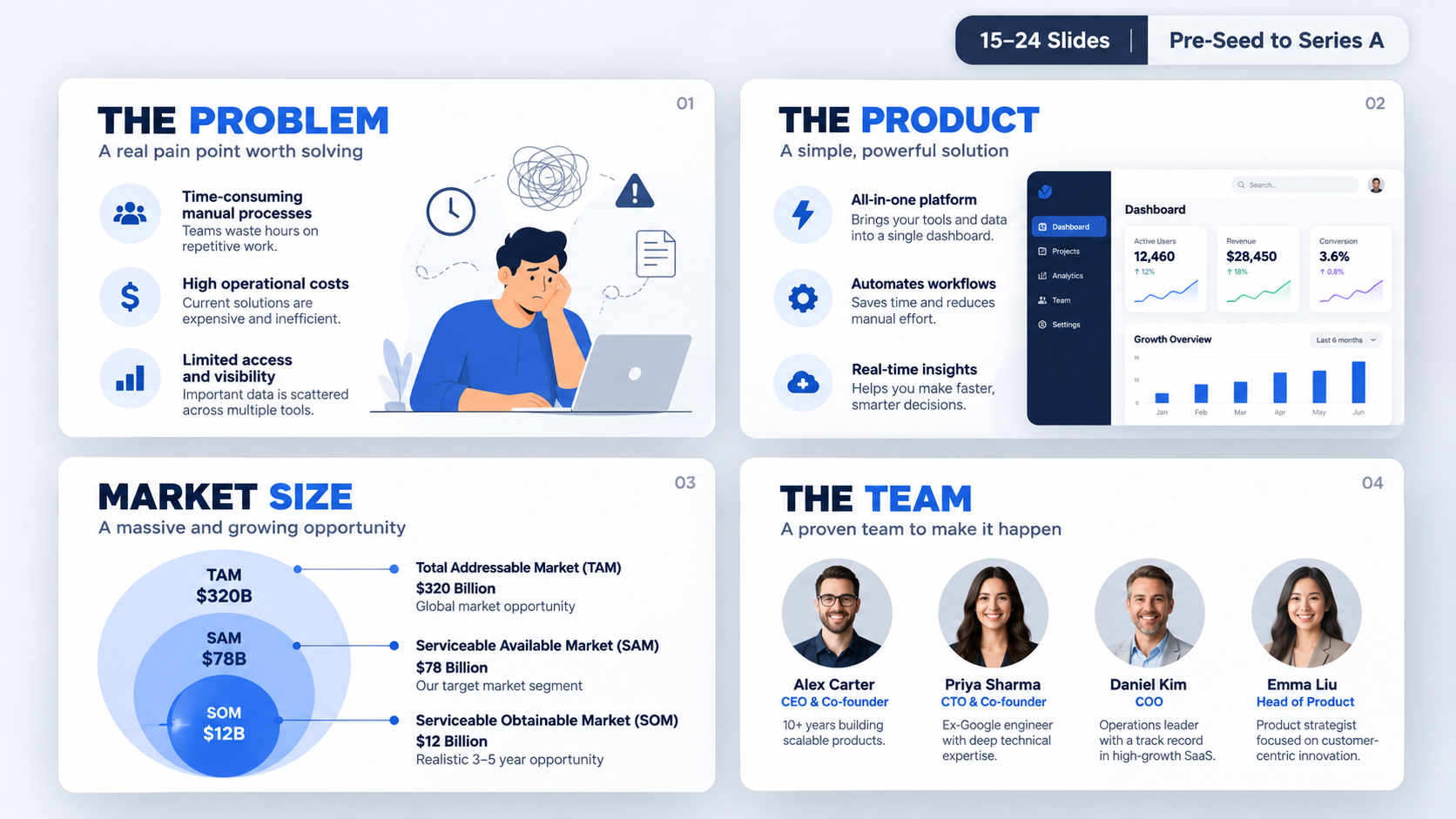
In business, the pitch deck is the standard document behind pre-seed to Series A meetings, accelerator applications, and demo days. It lays out the problem, the product, the market and the team in a form an investor can absorb in minutes. A common guideline is roughly 15-24 slides, adjusted by stage. A founder with no revenue usually needs fewer slides than a company with a traction story to tell.
What is a pitch deck presentation?
"Pitch deck" and "pitch deck presentation" describe the same document. The difference lies in delivery. An "email deck" is read on its own, so it carries more explanatory text. A presented deck is talked through live, so each slide stays lean, and the speaker supplies the detail.

What is a pitch deck for film?
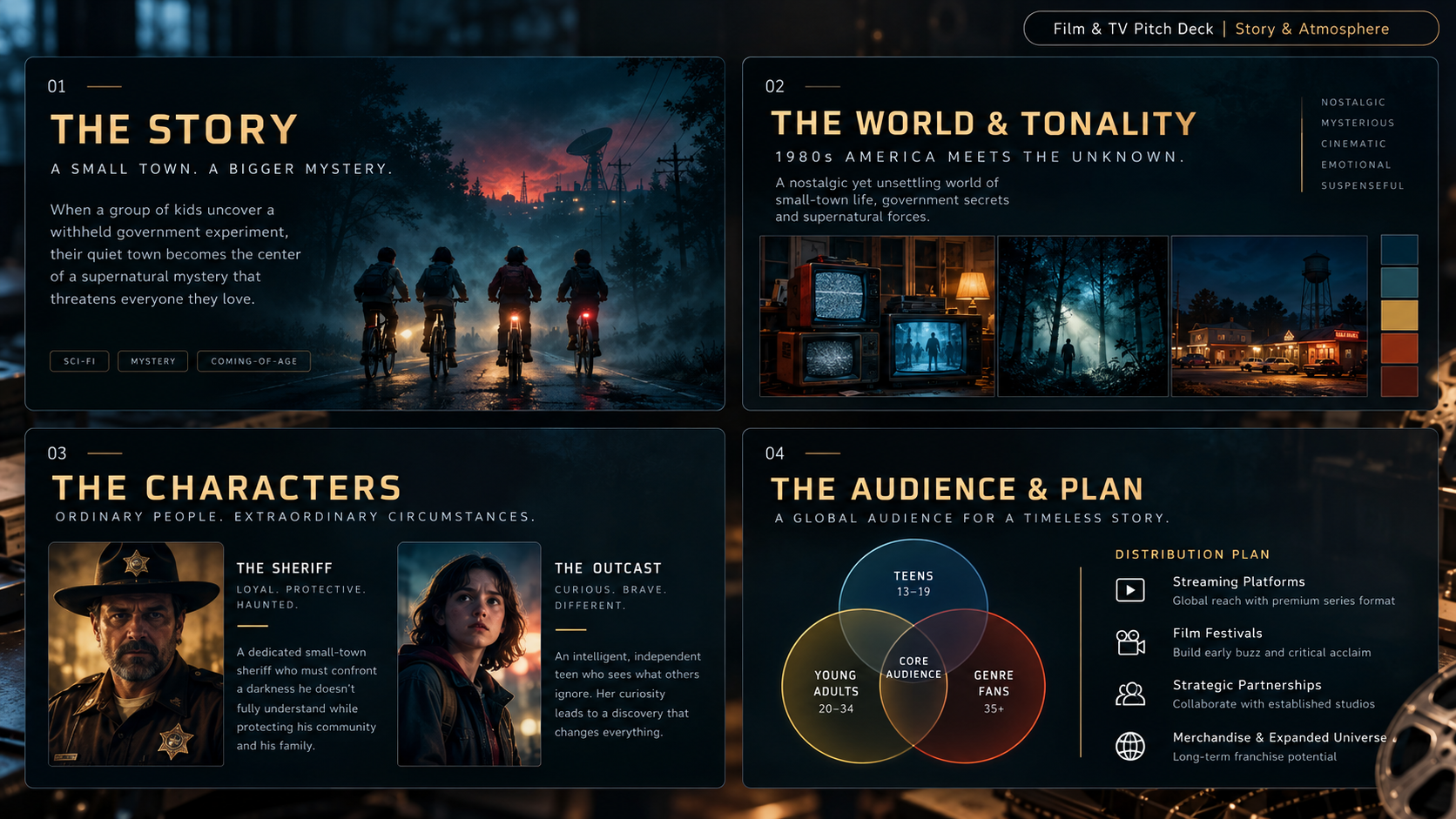
A film or TV deck sells a story rather than a company. It typically combines a mood board, a synopsis, character introductions, the target audience, and notes on distribution. A well-known example is the pitch behind Netflix's Stranger Things, which circulated under the working title "Montauk." It relied on imagery and tone to convey the feel of the series, paired with a short synopsis and a sense of where the story could go. Studios judge atmosphere and originality first, so visuals carry more weight here than in an investor deck.
What is a sales pitch deck?
A sales pitch deck is a client-facing presentation built around a prospect's specific problem. It centers on pricing, proof points, and a clear next step rather than fundraising. Where an investor deck sells future potential, a sales deck sells a solution to a present need, so case studies and measurable results replace market-size projections.

What is in a pitch deck? Core slides and structure
A pitch deck for business, whether it targets investors or clients, usually covers roughly 10-13 recurring slides in a set order, though the exact count depends on the story being told.
| Slide/section | What it answers | One-line tip |
|---|---|---|
| Problem | What pain exists, and for whom? | Use one concrete customer scenario. |
| Solution | How do you fix it? | State the benefit before the mechanism. |
| Product | What does it look like? | Show a screenshot or demo, not a feature list. |
| Market size | How big is the opportunity? | Define TAM, SAM, and SOM in one visual. |
| Business model | How does money come in? | Name the price and revenue source plainly. |
| Traction | What proof exists? | Lead with your strongest growth number. |
| Competition | Who else solves this? | Show your edge, not a crowded logo wall. |
| Go-to-market | How will you reach customers? | Name the first two channels only. |
| Team | Why you? | Tie each person to a relevant win. |
| Financials | Where is this heading? | Keep to three years of headline figures. |
| The ask | What do you need? | State the amount and what it unlocks. |
For market sizing, TAM, SAM, and SOM stand for the total market, the portion you can realistically serve, and the portion you can capture in the near term.
The three-part story arc
Investor decks commonly follow a three-part storytelling pattern. The setup describes the status quo and the problem. The turn presents the solution and shows how it works. The close delivers the proof: traction, team, and the ask.
A frequent beginner mistake is cramming a business plan's worth of detail onto one slide. A slide should support the presenter, who fills in the rest aloud.
How to make a pitch deck
Outline the story first, gather the supporting data, design the slides last, then test the deck on someone outside the company.

- Map the story arc: Write down the four or five questions the deck must answer, then arrange the slides around them.
- Gather real numbers: Collect evidence for market size, traction, and financials before touching a design tool.
- Design one idea per slide: Use minimal text, one message, and one supporting visual per slide.
- Get an outside read: Hand the draft to someone unfamiliar with the business and revise whatever confused them.
My go-to check is the stranger test: after reading the deck, can someone outside your industry explain the product back to you in two sentences? If they cannot, the problem and solution slides need rewriting.
Build the website behind your pitch deck with Enter Pro
A deck earns the meeting, but investors, partners, and early customers almost always look up the company's website next. Often it happens within minutes of the first email, before anyone has replied. A placeholder page, a broken link, or a site that contradicts the deck can undercut a strong pitch, because it signals that the company is less ready than its slides claim. Most founders know this, yet few have the time to hand-build a site in the weeks before a raise.
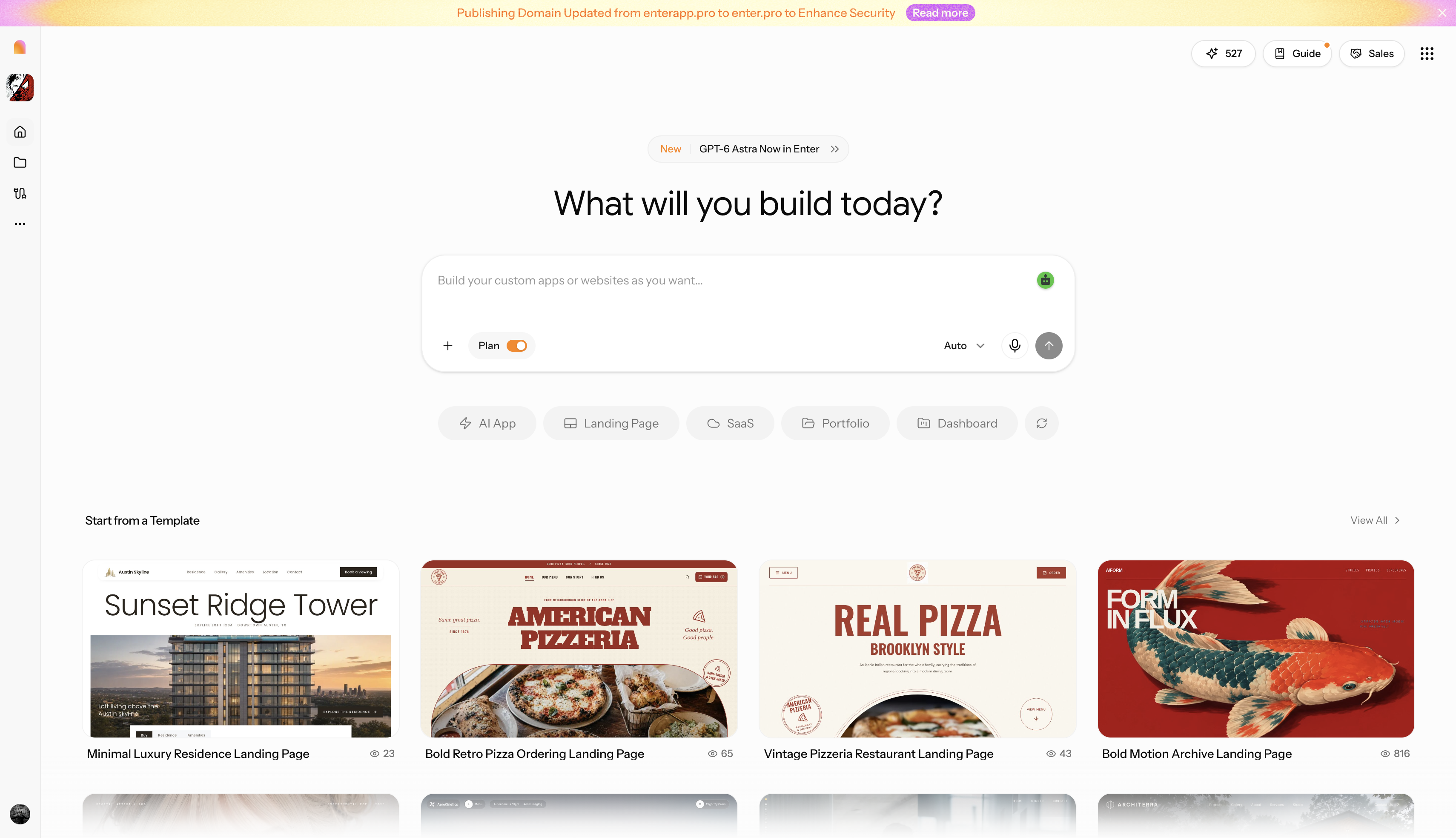
Enter Pro closes that gap by turning a plain-language description into a working site. You explain what the company does, who it serves, and what you are raising for, and the platform returns a structured site you can refine. The result is a live, credible web presence that repeats the deck's story: the problem, the solution, and the proof. It is a companion step to the deck, not a replacement for it. The deck still does the persuading, while the site gives interested readers somewhere to verify what they have just seen.
Key features of Enter Pro for founders preparing to pitch
- AI website builder
Describe the company in a few sentences, such as the problem you solve, your target customer, and your traction so far, and the AI website builder follows a prompt-to-site workflow that returns a working multi-page site. Because the output mirrors your description, the site's wording stays consistent with the deck.
- Landing page builder
A full site is often premature at pre-seed. In that case, the landing page builder produces a focused single page built around one action, such as joining a waitlist, booking a call, or requesting the deck. That keeps visitors from wandering through half-finished pages.
- AI for founders
Early-stage work rarely stops at design. Messaging, positioning, and getting a fast public presence all compete for the same few hours, and AI for founders is aimed at exactly those workflows, so the site's headline and value proposition get sharpened alongside the build rather than after it.
- Visual editor
Once the site is generated, you can change text, images, and layout with point-and-click edits directly on the page. Updating a traction number or swapping a team photo the day before a meeting takes seconds, with no code involved.
- Website templates
Startup and portfolio-style starting layouts replace the blank page. A template gives you a proven section order, such as hero, problem, product, team, and contact, which you can then adapt to the deck's slide sequence.
How to build a website with Enter Pro in 3 steps
Step 1: Input your company site prompt
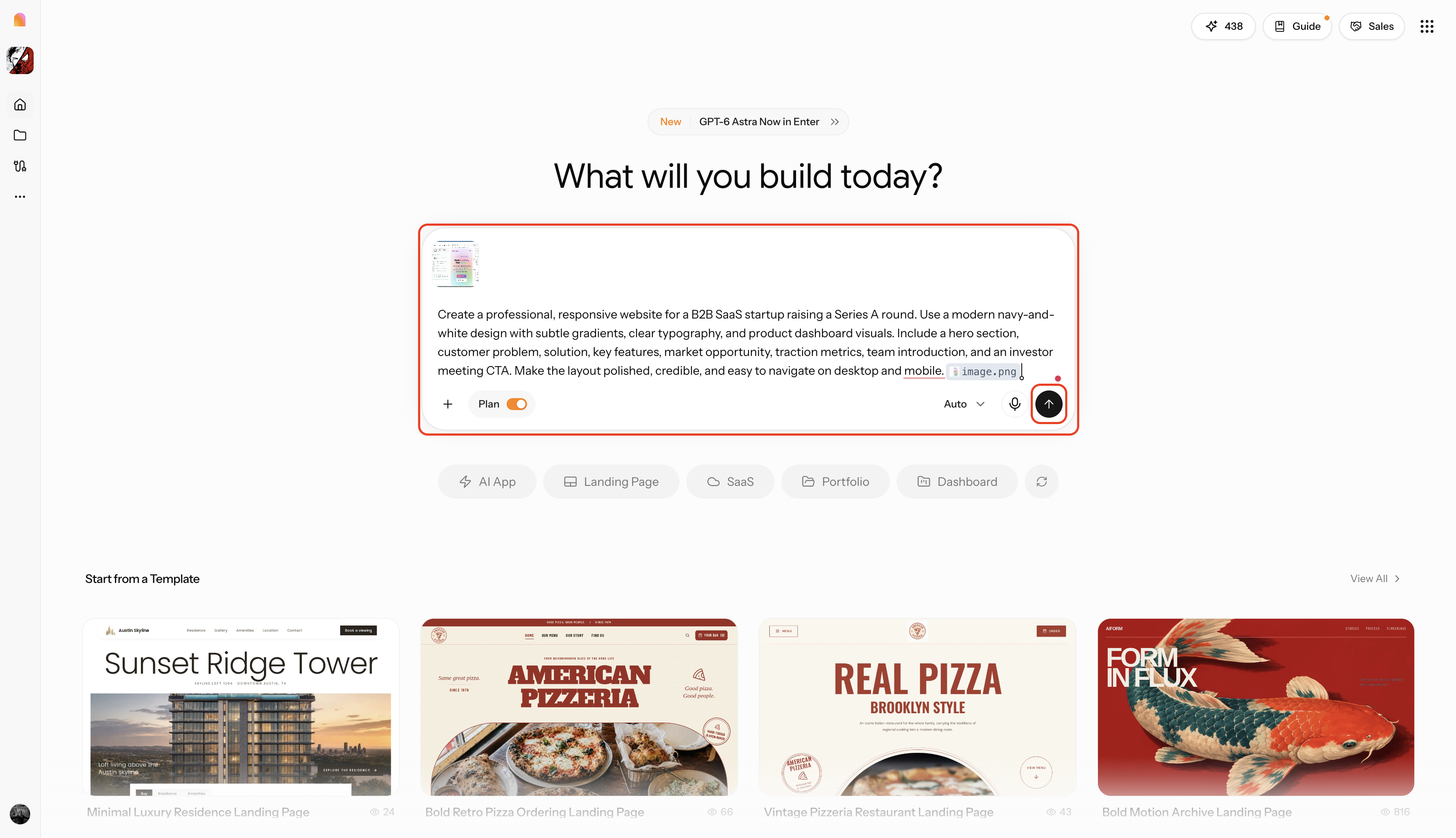
Describe the company, the raise, the styling you prefer, and the sections you want in plain language. A sample prompt might name the product, the target customer, the stage, and the single action you want visitors to take. You can also upload a screenshot, such as a site you admire or a slide from your deck, so the AI picks up the structure and looks from the start.
Step 2: Refine copy, images, and sections
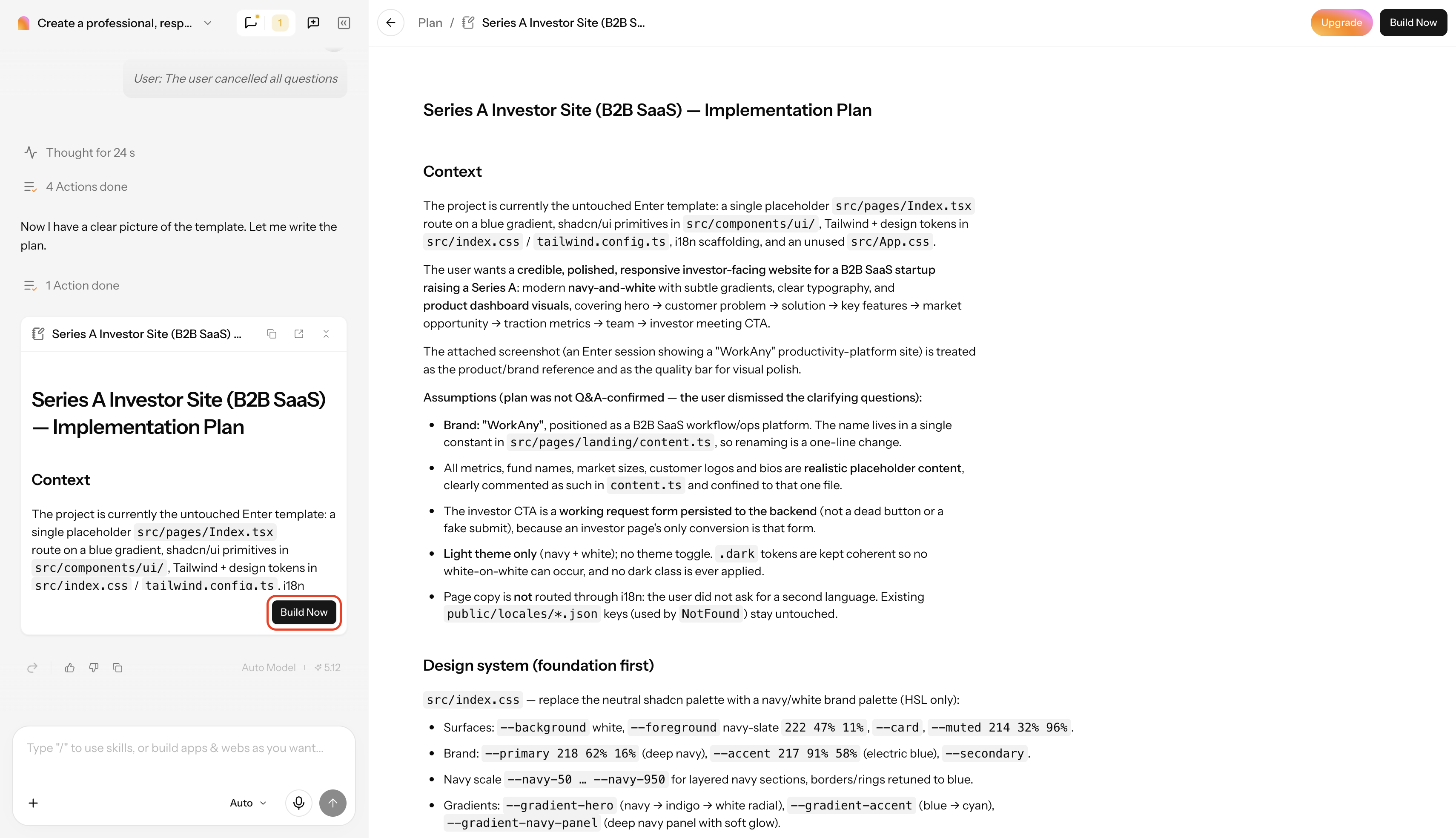
Before anything is generated, Enter Pro shows a plan outlining the site's context, design direction, and file structure. Check that the plan matches the deck's story, including the problem, solution, and ask. When it does, click the "Build Now" button to start generation.
Step 3: Publish and share the link alongside the pitch deck
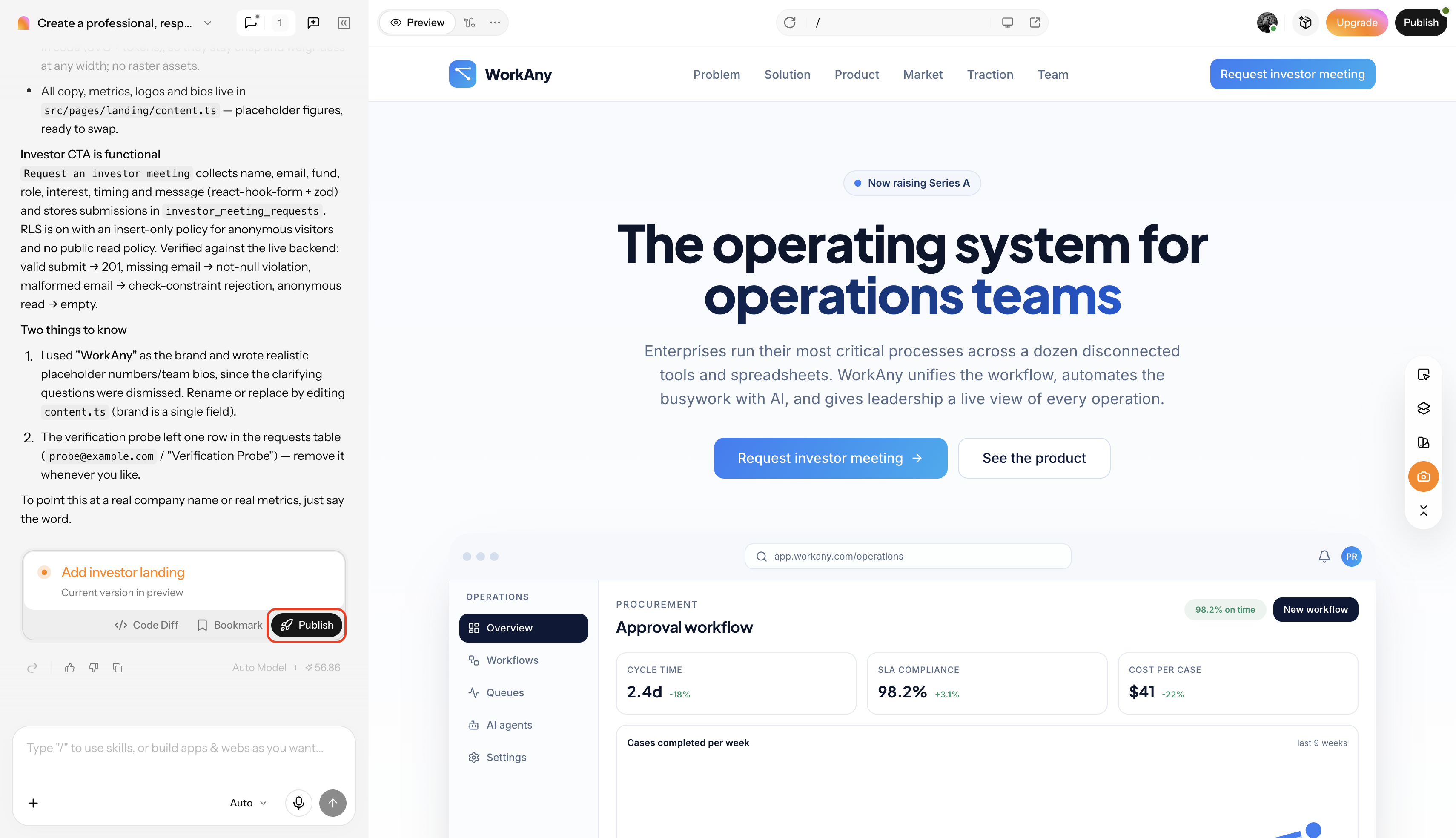
Refine the generated site by describing changes in a prompt or by using the visual editor. Tighten the headline, swap in product screenshots, and reorder sections to follow the deck's arc. When you are satisfied, deploy the site live with a single click, or export the source files to your computer if you plan to host it yourself. Then add the live link to the deck's closing slide and your email signature.
Conclusion
What is a pitch deck? It is a short visual summary that earns a follow-up conversation, whether the end goal is funding, a greenlight, or a client. The three common types, business, film, and sales, differ in emphasis but share a logic: the problem, the solution, the proof, and the ask. Nearly all of them rely on the same core slides, from market size to team to financials. Build the story first, test it on an outsider, and give investors a credible site to land on once the deck has done its work. Enter Pro can handle that website step. Try it today to build your site with ease!
FAQs about what a pitch deck is
Is a pitch deck just PowerPoint?
No. PowerPoint is one tool for making a deck, but the deck is the content, not the software. Founders also build decks in Keynote, Google Slides, Canva, or Figma, and many export to PDF for sharing. The format matters less than the story and the clarity of each slide.
Can ChatGPT create a pitch deck?
AI chat tools can draft an outline, slide headlines, and talking points. They cannot supply your real traction, financials, or market data, so those must come from you. Treat the output as a first draft, then verify every number before an investor sees it. Once the deck is settled, Enter Pro can turn the same company description into the website that backs it.
What is the 10/20/30 rule for a pitch deck?
Popularized by Guy Kawasaki, the rule suggests 10 slides, a 20-minute presentation, and a minimum 30-point font. It aims to keep a deck focused and readable. Many founders treat it as a guideline rather than a fixed requirement, especially when sending a deck by email.
How much should a pitch deck cost?
Costs range widely. A founder can build one for free from templates, while design agencies and consultants may charge from a few hundred to several thousand dollars. Pay for design only after the story and numbers are settled.
How many slides should a pitch deck have?
A common range is roughly 15-24 slides for an investor deck, adjusted by stage. Earlier-stage companies often need fewer. Film and sales decks vary by audience, but fewer, clearer slides generally outperform long ones.
What is the difference between a pitch deck and a business plan?
A pitch deck is a brief, visual summary meant to start a conversation. A business plan is a detailed written document covering operations, finances, and strategy in depth. Founders usually lead with the deck and share the plan only when asked.
Do I need a website in addition to a pitch deck?
In practice, yes. Investors, partners, and customers typically search for a company after seeing its deck, so a credible website supports the pitch. At an early stage, a one-page site or landing page is often enough, and Enter Pro can generate either from a plain-language description of the company and the raise.